
This article provides a complete CSS guide for anyone asking, “What is CSS?” and how to pass the CSS Exam in Pakistan. The Central Superior Services (CSS) Examination is the nation’s most competitive and prestigious national exam. The Federal Public Service Commission (FPSC), an independent government body, conducts this rigorous assessment every year.
For decades, the CSS exam has served as the primary gateway for recruiting talented, disciplined, and capable individuals into the Pakistan’s bureaucratic elite. Successful candidates, often called bureaucrats, are appointed to coveted government officer posts at the Basic Pay Scale-17 (BPS-17). Consequently, they assume critical responsibilities in shaping the nation’s governance, managing government secretaries, and running civil bureaucratic operations.
The History and Evolution of the CSS Exam
The British colonial period is when the civil service exam in Pakistan first started. The British set up the Indian Civil Services (ICS) exams to find skilled people to run British India.
This system of government was used by the new country of Pakistan after it became independent in 1947. The first civil service exam in Pakistan was held in 1948. It was based on the British model and tested people on subjects like English, law, and history.
The CSS exams have changed a lot over the past 70 years. This change is a response to Pakistan’s changing needs in terms of governance and society. The exam has grown to cover a lot of different job groups, like police, customs, and foreign services. Also, subjects like Islamic Studies, Pakistan Studies, and regional languages were added to make sure that candidates know a lot about the country.
The Federal Government hires successful candidates into one of twelve established service groups:
- Commerce and Trade Group
- Pakistan Customs Service (formerly Customs and Excise Services)
- Pakistan Administrative Services (formerly District Management Group)
- Foreign Service of Pakistan
- Inland Revenue Service (formerly Income Tax Group)
- Information Group
- Military Lands and Cantonments Group
- Office Management Group
- Pakistan Audit and Accounts Service
- Police Service of Pakistan
- Postal Group (formerly Postal Services Group)
- Railways (Commercial and Transportation) Group
The Five-Stage Process of the CSS Exam in Pakistan
The CSS examination is a comprehensive process designed to evaluate an applicant’s knowledge, abilities, and intellectual aptitude. Candidates must successfully pass through a mandatory five-part structure.
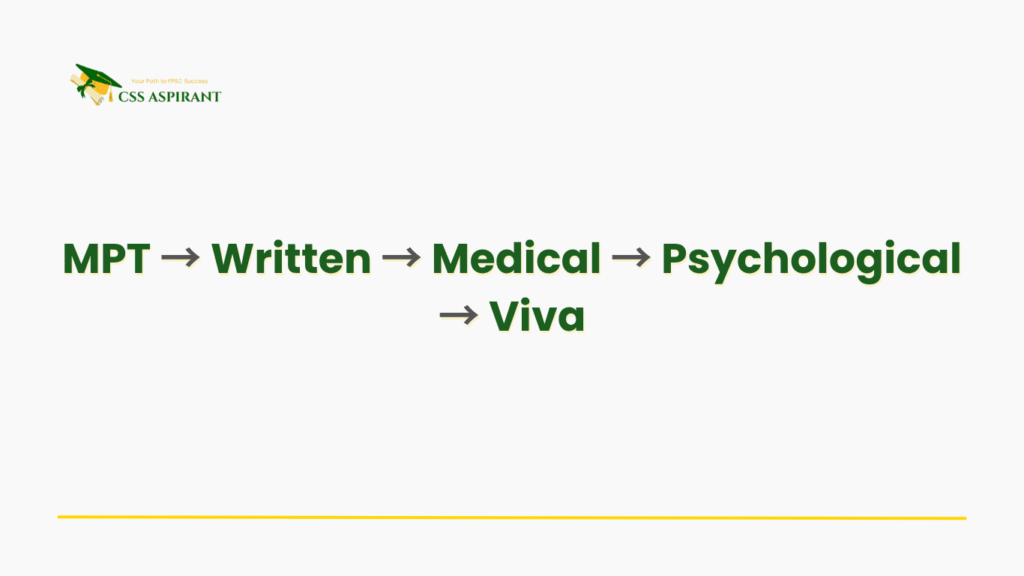
The entire process has a total of 1500 marks. These are divided between the written exams (1200 marks) and the final interview, or Viva Voce (300 marks).
1. The MCQ Preliminary Test (MPT)
This is a newer part of the process, added back in 2022. The MPT is the very first screening step. It’s basically designed to filter candidates before they get to the main written exams. This test checks your general knowledge, your grasp of current affairs, and your basic understanding of the compulsory subjects. You have to hit the minimum passing score to qualify for the written examination stage. Simple as that.
2. The Written Examination
This is the main theoretical test phase, and it’s a big one. It’s made up of 12 papers. These papers are evenly split into six compulsory subjects and six optional subjects.
Compulsory Subjects
The six compulsory subjects are worth a total of 600 marks, with each paper valued at 100 marks. These subjects are:
- English Essay
- English (Précis and Composition)
- General Science and Ability
- Current Affairs
- Pakistan Affairs
- Islamic Studies (or Comparative Study of Religions for non-Muslims)
To qualify for the next phase, a candidate must achieve at least 40% marks in each of these compulsory papers.
Optional CSS Exam Subjects in Pakistan
The optional subjects also account for 600 marks. Candidates select these subjects from a diverse list of approximately 45 subjects, which the FPSC organizes into seven distinct groups.
Candidates must ensure their selected subjects add up to exactly 600 marks. Subjects can be worth 100 marks (one paper) or 200 marks (two papers, like Economics Paper I and Paper II).
To qualify in the optional papers, a candidate must score a minimum of 33% marks in each subject they have selected.
Finally, to pass the written test stage as a whole, the applicant needs to achieve an overall score of 50% marks (600 out of 1200) for all 12 papers.
3. The Medical Test
Passed the written part? Great. Next up is the medical test.
This one’s mandatory, so everyone has to go through it. It’s really just to confirm you’re physically fit for the demands of a public service job.
And for anyone wondering—yes, candidates with special needs are absolutely eligible for the CSS exam. This includes physical, hearing/speech, or visual impairments. You just have to get a disability certificate from the proper authorities and submit it in advance.
Typically, these candidates are shortlisted for four specific disciplines: Pakistan Audit and Account, Postal Service, Commerce and Trade, and Information Services.
4. The Psychological Test
After the medical test, candidates move on to the Psychological Test. This assessment is designed to get a sense of the applicant’s mental, behavioral, and attitudinal characteristics. The whole point is to determine if they actually have the essential traits that are required for a long-term career in the civil services.
5. The Viva Voce (Oral Interview)
The final hurdle is the Viva Voce—a 300-mark formal interview.
This is where they test a candidate’s mental talents, including things like their attentiveness, moral character, and general sharpness. It’s also a chance to assess their grasp of content, their general knowledge, how prepared they are for current situations, and, most importantly, their confidence.
To pass this last stage, a candidate has to score a minimum of 33%. That means pulling in at least 100 out of 300 marks in the Viva Voce.
Navigating the CSS Exam Syllabus and Subject Selection In Pakistan
The process of selecting your optional subjects is critically important and should be the very first step in your preparation journey. Many aspirants later regret their choices, so a strategic, objective analysis is essential from the start. You should never select a subject based only on an academy’s or another person’s recommendation.
Optional Subject Groups (The 600-Mark Framework)
The detailed syllabus organizes optional subjects into seven groups. Candidates must select subjects that total 600 marks, following specific rules for each group.
- Group-I (Select one subject of 200 marks):
- Accountancy & Auditing (200)
- Economics (200)
- Computer Science (200)
- Political Science (200)
- International Relations (200)
- Group-II (Select subject(s) of 200 marks):
- Physics (200)
- Chemistry (200)
- Applied Mathematics (100)
- Pure Mathematics (100)
- Statistics (100)
- Geology (100)
- Group-III (Select one subject of 100 marks):
- Business Administration (100)
- Public Administration (100)
- Governance & Public Policies (100)
- Town Planning & Urban Management (100)
- Group-IV (Select one subject of 100 marks):
- History of Pakistan & India (100)
- Islamic History & Culture (100)
- British History (100)
- European History (100)
- History of USA (100)
- Group-V (Select one subject of 100 marks):
- Gender Studies (100)
- Environmental Sciences (100)
- Agriculture & Forestry (100)
- Botany (100)
- Zoology (100)
- English Literature (100)
- Urdu Literature (100)
- Group-VI (Select one subject of 100 marks):
- Law (100)
- Constitutional Law (100)
- International Law (100)
- Muslim Law & Jurisprudence (100)
- Mercantile Law (100)
- Criminology (100)
- Philosophy (100)
- Group-VII (Select one subject of 100 marks):
- Journalism & Mass Communication (100)
- Psychology (100)
- Geography (100)
- Sociology (100)
- Anthropology (100)
- Punjabi (100)
- Sindhi (100)
- Pashto (100)
- Balochi (100)
- Persian (100)
- Arabic (100)
A Strategic Approach to Choosing Your Subjects
Your selection criteria must be based on objective analysis. Use the following five-point strategy to make the best choice for you.
- Analyze the Syllabus: First, examine the subject’s syllabus. Is it lengthy or short? Does the content seem difficult or relatively easy for you to grasp?
- Review Past Papers: Next, analyze the past 10 years of exam papers for that subject. Determine the nature of the questions. Subjects with straightforward questions (like Criminology since 2016) are often preferred over those with tricky or “twisted” questions.
- Investigate Scoring Trends: You must consider the subject’s scoring trend over the last 10 to 20 years. It is strongly advised against selecting subjects that consistently result in poor scores for most candidates. The exam is not the place for “experiments” or trying to single-handedly change a scoring trend.
- Assess Personal Interest: Your personal interest in the subject is vital. If you lack interest (e.g., you struggle to memorize dates for history subjects), it will be very difficult to succeed.
- Find the ‘Overlap’: Finally, the concept of ‘overlap’ is crucial. Selecting an optional subject that overlaps with compulsory subjects can provide a significant advantage. For example, International Relations overlaps heavily with Current Affairs and Pakistan Affairs. This overlap can be as high as 50%, whereas a subject like Pashto might offer no overlap at all.
Some combinations are considered “matching”. For instance, Political Science pairs well with Public Administration, Governance & Public Policy (GPP), Gender Studies, or US History. Similarly, International Relations can be effectively combined with Criminology, US History, or Gender Studies.
Requirements For CSS Exam In Pakistan
To appear in the CSS Exam in Pakistan, an applicant must meet stringent legal requirements. These relate to nationality, education, and age. You must satisfy all criteria by the 31st of December of the year preceding the examination (this is the cut-off date).
Nationality and Domicile
The applicant must be a citizen of Pakistan or a permanent resident of the state of Jammu and Kashmir. Dual citizens are allowed to take the exam. However, if they successfully pass and are appointed, they must relinquish their foreign citizenship.
Furthermore, a Pakistani domicile is absolutely necessary. Seat allocations for the different service groups are determined based on a candidate’s domicile.
Age Requirements For CSS Exam Pakistan
A candidate must be between the ages of 21 and 30 years. This age is calculated precisely on the 31st December cut-off date.
Age Relaxation (Up to 32 Years)
A relaxation of two years in the upper age limit (allowing candidates up to 32 years old) is granted for specific categories:
- Candidates belonging to Scheduled Castes and the Buddhist Community.
- Candidates belonging to recognized tribes and specific areas, including Baluchistan, Tribal Areas of D.I. Khan and Peshawar Divisions, and parts of Dera Ghazi Khan and Rajanpur Districts, among others.
- Permanent residents of Azad Kashmir and Gilgit-Baltistan.
- Candidates who are disabled (physically, hearing/speech, or visually impaired).
- Candidates currently serving as government employees with a minimum of two years of continuous service. (Note: Employees of Banks, WAPDA, Regulatory Authorities, and Autonomous bodies are not eligible for this relaxation).
Educational Qualification for CSS Exam in Pakistan
The applicant must possess a Bachelor’s Degree with at least a 2nd Division or Grade ‘C’. This degree must be from a university recognized by the Higher Education Commission (HEC) of Pakistan. An equivalent qualification of 14 years of formal education is also accepted.
A candidate holding a 3rd Division or Grade ‘D’ in their Bachelor’s degree can only apply if they have subsequently secured a Higher Division or Grade in their Master’s Degree.
Attempt Limit
A candidate is restricted to appearing in the CSS examination a maximum of three times. A chance is considered consumed if the candidate appears in even one paper of the exam.
The Power and Prestige: Why CSS is a National Ambition
The CSS Exam in Pakistan opens pathways to one of the nation’s most prestigious careers, offering profound influence and economic stability. This combination contributes to the widespread societal obsession with the civil services.

A Career of Stability and Influence
So, what happens when you clear the exams? You’re selected by the government for a BPS-17 officer position, and just like that, you become part of the permanent bureaucratic elite. In a developing country like Pakistan—which, let’s face it, often deals with severe economic challenges, high inflation, and job scarcity—the role of a civil servant becomes a powerful symbol of aspiration. It’s really seen as a path toward a more settled, prestigious, and secure life.
Economic Benefits and Perks
The salary for a BPS-17 position is a big draw. It’s significantly higher than most public or private sector jobs in the country, providing some robust economic stability.
But it’s not just the high salary. CSP (Central Superior Services of Pakistan) officers enjoy an extensive range of perks and privileges. We’re talking about the government often fully covering expenses like petrol costs, utility bills, food, and official residences. On top of that, officers also get international travel opportunities and a clear path for career advancement.
This comprehensive coverage allows them to save substantially more money than their private-sector counterparts.
The Societal Value
Cultural and societal factors definitely fuel this ambition, too. In Pakistani society, holding a position within the civil services commands immense prestige and a whole lot of respect. There are these sociological concepts, like “social facts,” which basically say that dominant cultural expectations mold how we behave. This just reinforces that perception that a government job gives you high social status and honor. And, of course, family expectations often play a huge part in driving that.
Power, Networking, and Public Service
Let’s be real: CSS officers have a ton of power and influence.
They’re right at the heart of decision-making in government agencies and get access to information that most people never see. This position lets them literally shape policy, draft laws, and advise the nation’s top leaders on critical issues.
You can see how that kind of power is a huge motivator, right? Especially for people who genuinely want to make a positive difference and help fix those major socio-economic problems.
And that’s not all. Being a CSS officer opens doors you just won’t find anywhere else—like getting to interact with experts from all kinds of fields. That’s just fantastic for your own personal growth and for building an influential network.
Now, look, wanting to grow as a person and be financially secure is perfectly understandable. But the main goal for taking on a role this important has to be grounded in principles. Understanding “what is CSS” is the first step; committing to the whole journey is the next.
And that commitment has to mean stepping up, being responsible, dedicating yourself to honest public service, and making good on your pledge to the state.
Conclusion
Look, the CSS Exam is more than just a job. It’s a real commitment—to public service, to the nation’s development, and to your own personal growth. If you’re an aspiring candidate, you have to focus on your preparation, be smart about which subjects you select, and stick to a disciplined study schedule. That’s what it takes to succeed in one of Pakistan’s most prestigious examinations.

Shayan Nasir is the founder of CSSAspirant.com. As a dedicated CSS aspirant with nearly five years of first-hand experience, he shares practical strategies and insights from his journey. He holds a Bachelor's degree in Political Science from GC University Faisalabad.
Pingback: Is the CSS Exam Difficult? - cssaspirant.com
Pingback: How to Prepare for CSS Exam in Pakistan - cssaspirant.com
Pingback: How to Choose CSS Subjects: A Topper's Inside Guide - cssaspirant.com
Pingback: Best general knowledge books for CSS: An Expert Guide - cssaspirant.com
Pingback: How to Prepare Political Science for CSS: A Comprehensive Guide - cssaspirant.com
Pingback: Which Degree is Best for CSS? The Strategic Path to Success - cssaspirant.com